Decision audit trail
Explain the decision. Keep the evidence.
See why a package was allowed or blocked, which project requested it, and the rule that decided it. Keep the records and policy history in your own database.
Start with the request that needs explaining
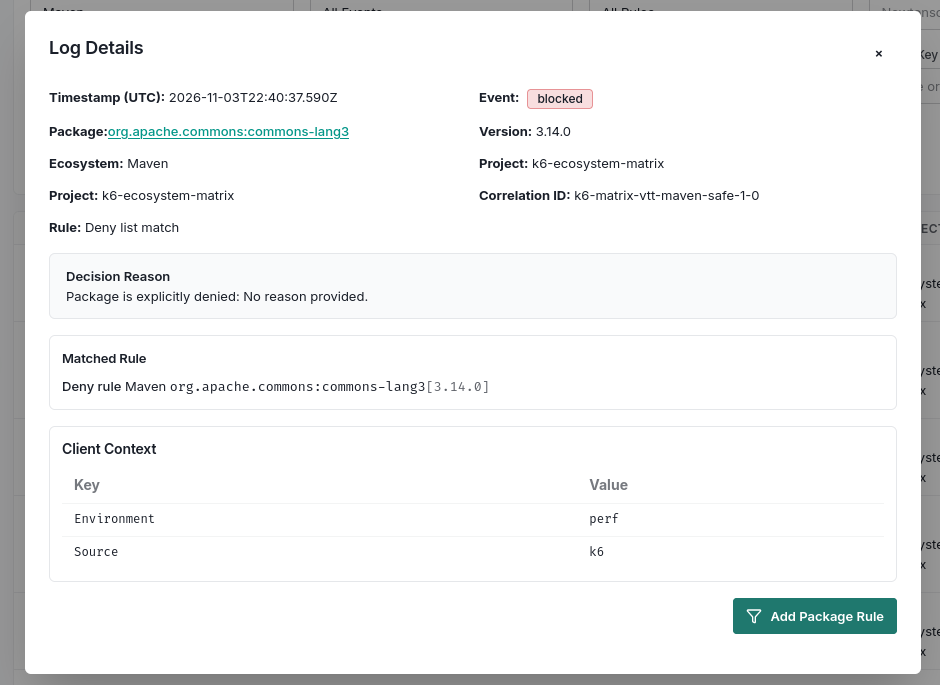
Filter the Logs page by package, version, project, time, or deciding rule. Open an event to see its reason and the context attached to the request, including a correlation ID that can connect requests from one build.
The screenshot shows an explicit deny-list match for a Maven version. Its matched rule explains the block; the project and client context identify the request.
Read the rule as it stood then
Events decided by an allow or deny rule store that rule’s ID. Editing a rule supersedes the old row; removing it preserves its history. The event can still resolve to the version of the rule that made the decision.
Policy-driven events instead identify the deciding check, such as a denied license or CVSS threshold. Older events recorded before decision-rule details existed do not gain those details retroactively.
Compare policy before and after a change
The workspace audit log records who changed security settings, package rules, or vulnerability exceptions, with the values before and after. Imports and bulk removals retain the individual rule changes.
The API’s settings-as-of export returns historical security setting values and who last changed them. It complements the rule history and event records; it is not a replay of past advisory intelligence.
Hand over evidence without copying console screens
- Decisions CSV: recorded allowed and blocked events over a chosen period, including the deciding rule and matched rule ID where available.
- Policy changes CSV: one row per changed setting or rule, with the actor and before-and-after values. Available to administrators.
- Settings-as-of CSV: security settings at a chosen moment, available through the API.
Decision and policy-change exports are streamed without a row cap. Events live in your database and are retained indefinitely by default; operators can set a retention period. Deleted historical events cannot be reconstructed by an export.
Explore related capabilities
Test it on your infrastructure
Use the 30-day on-premises trial to validate your package managers, policies, and operations. Prefer a first look? The separate 7-day hosted Portal evaluation uses synthetic package activity.